
Rush and Endeavor Build a Nearly $11 Billion System on Razor-Thin Margins
Rush University System for Health and Endeavor Health plan to merge into a 12-hospital, nearly $11 billion academic system under the Rush name. Both run on margins near 1%. Paxton-Digital breaks down the terms, the $1 billion pledge, the open regulatory questions and the margin math.
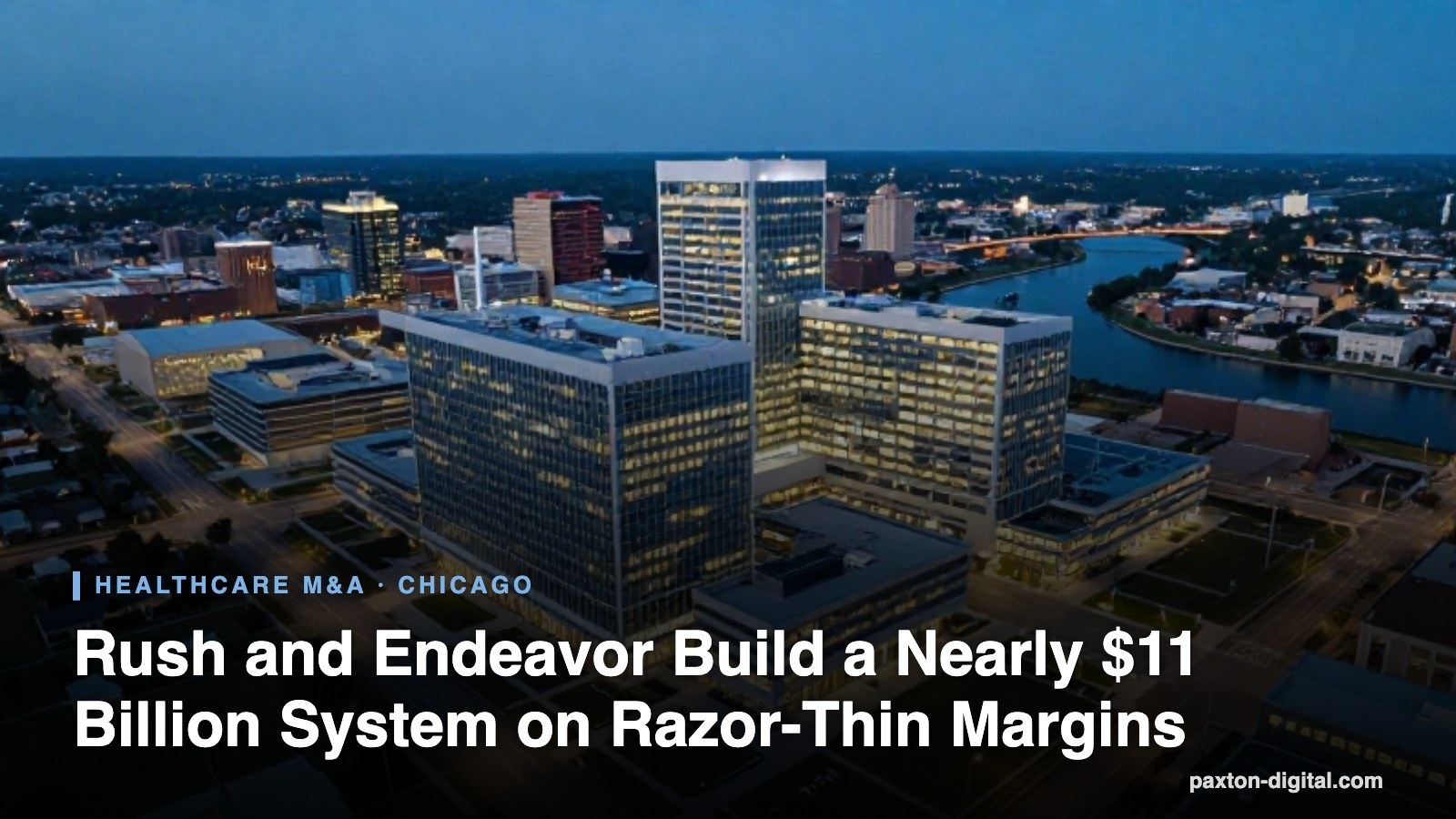
Oct. 15, 2026 — Chicago’s hospital map is about to be redrawn again. On Wednesday, Rush University System for Health and Endeavor Health announced plans to merge into a single nonprofit academic health system with 12 hospitals, more than 400 care sites, more than 46,000 employees and nearly $11 billion in combined annual operating revenue. If regulators sign off, it would be the largest health system in Illinois by hospital count.
No money is changing hands in the usual sense. This is a merger of two nonprofits, not a buyout. But the economics underneath it are the real story, and they say a great deal about where large health systems are heading.
The confirmed terms
The following details were announced by the two systems and reported consistently by the Chicago Sun-Times, CBS Chicago, ABC7 Chicago, Fierce Healthcare and Becker’s Hospital Review:
- Name: the combined system will operate as Rush. Endeavor’s hospitals, including Evanston, Edward, Elmhurst, Swedish and Northwest Community, keep their local names.
- Leadership: Endeavor CEO Gerald “J.P.” Gallagher becomes president and CEO of the unified system. Rush CEO Dr. Omar Lateef stays through closing, then becomes CEO emeritus and strategic adviser.
- Governance: a 20-member board split evenly between the two organizations, chaired by a Rush representative.
- The $1 billion commitment: Endeavor will fund an incremental $1 billion, with $300 million for community impact, $500 million for academics and research, and $200 million for quality and care innovation. No timeline has been given for that spending.
- Timing: the systems are targeting a close in early 2027, subject to regulatory review and approval.
Why now: look at the margins
Fierce Healthcare dug into the financials, and the numbers explain the logic better than any press release. Rush reported $4.4 billion in operating revenue for the 12 months ended June 30, 2026, with operating income of $56.6 million, a margin of about 1.3%. Endeavor reported $6.4 billion in revenue for calendar 2025 and an operating loss of $33.9 million. Excluding legal settlement costs, Endeavor was slightly positive at a 0.4% margin. Its bottom line was a healthy $663 million, but that came mostly from investment gains, not from treating patients.
Put simply: two large, respected systems are running hospitals at or near break-even and leaning on their balance sheets to stay strong. That is the pattern across much of American nonprofit health care right now. Scale is the main lever left, through purchasing power, shared back-office costs, consolidated IT, and more leverage in contract talks with insurers.
Gallagher, for his part, rejected the idea that economic pressure forced the deal. He described it to the Sun-Times as “a long-term bet” on being able to withstand those pressures rather than a response to any one of them. Both statements can be true. A system does not need to be in trouble to see that the next decade will reward size.
What each side brings
Rush brings an academic medical center, a health sciences university and a brand with national recognition. That is why the combined system takes its name. Endeavor, itself the product of the 2022 merger of NorthShore University HealthSystem and Edward-Elmhurst Health, brings reach: nine hospitals across Chicago’s north and west suburbs and a large outpatient network. The pitch is a classic hub-and-spoke model. Patients get routine care close to home and move to Rush’s academic center for complex cases and clinical trials.
What is not settled
Several important questions remain open, and we want to be clear about which parts are reporting rather than confirmed fact.
- Regulatory review. The announcement says only that the deal is subject to review. None of the coverage we reviewed named the agencies involved or described any concerns. Large hospital combinations in a single metro area often draw antitrust scrutiny, so the early-2027 target is a goal, not a guarantee.
- Nurses and labor. The Sun-Times reported that nurses at Rush University Medical Center voted earlier this year to unionize and that nurses at several Endeavor hospitals are organizing. It is unclear what the merger means for those efforts. Gallagher said the system is listening to and investing in its nurses.
- Prices. Neither system has said what the merger would mean for what insurers and patients pay. Research on hospital consolidation has often found higher prices afterward, which is exactly what regulators will look at.
Paxton-Digital’s Take
This is a margin story dressed as a mission story. The $1 billion commitment is real and meaningful, and the community, research and workforce goals are worth taking seriously. But the reason two systems with roughly 1% margins choose to combine is that 1% of $11 billion in expenses is about $100 million a year. In a business this thin, that is the difference between growth and treading water. Use the calculator below to see how quickly modest savings move the needle.
The deal fits a national pattern. Regional systems are combining into super-regional academic networks with one flagship brand. Investors in health services, suppliers and payers should expect fewer, larger counterparties with more pricing leverage on both sides of the table.
Watch the regulators, not the press release. The real test is whether reviewers accept the access and quality arguments, and whether they attach conditions on pricing or labor. That process, not Wednesday’s announcement, will decide what this system actually looks like in 2027.
Margin math: what does 1% of savings buy?
Defaults use each system’s most recent reported figures (different fiscal years). Change the inputs to test your own assumptions.
Deal quiz: Rush + Endeavor
Tap an answer to reveal the explanation. Your score appears at the end.
Talk it over
- Do mergers like this improve access for patients, or mostly increase the system’s bargaining power with insurers?
- Should regulators require price commitments as a condition of approval?
- How should the combined system prioritize the $1 billion: community programs, research, or workforce?
Sources
- Endeavor Health, Rush announce proposed merged healthcare system — Chicago Sun-Times, Oct. 14, 2026
- Chicagoland’s Rush, Endeavor unveil nearly $11B healthcare merger — Fierce Healthcare
- Rush University System and Endeavor Health announce merger — CBS Chicago
- Rush University System for Health, Endeavor Health announce merger plans — ABC7 Chicago
- Rush, Endeavor to merge — Becker’s Hospital Review
- More Consolidation in Chicagoland: Endeavor, Rush Seek to Merge — Healthcare Innovation
Featured image: AI-generated illustration (DeepAI). Paxton-Digital is independent of Rush University System for Health and Endeavor Health. This article is for information only and is not investment advice.